Tuesday, January 20, 2015

Phi Phi Farewell

Although the students are already back in Columbia, I wanted to finish posting entries to the blog.  My entries were temporarily suspended for several reasons.  On our last day in Phi Phi, Andrew threw a farewell party for us in which he had some drinks and fresh seafood.

Divemaster Daphne with her group.
Divemaster Jade.
Instructors (and soon to be married) Chris and Karen with Rachel and Jordan in the middle.
various scenes from the party...


Natalie asking where all the chicken went, as Ajarn Wayne eats his chicken.
Mor Mark looking for the chicken.

Tuesday, January 13, 2015

Reef evaluation using Reef Watch protocol.

Today's our last day of diving and included evaluating a reef with the Reef Watch protocol.


We met at the dive shop every day this week at 7:00.
Leaving the dive shop. We walked down a couple of streets to the pier where the dive boat was waiting for us.
Upstairs above the dive deck waiting to get underway.
A couple scenes before we started the reef evaluation.  Here is a bit of a large school of white-streak monocle breams in front of a barrel sponge.
A Kuhl's ray swam by.
Mor Mark holding the reef watch booklet.
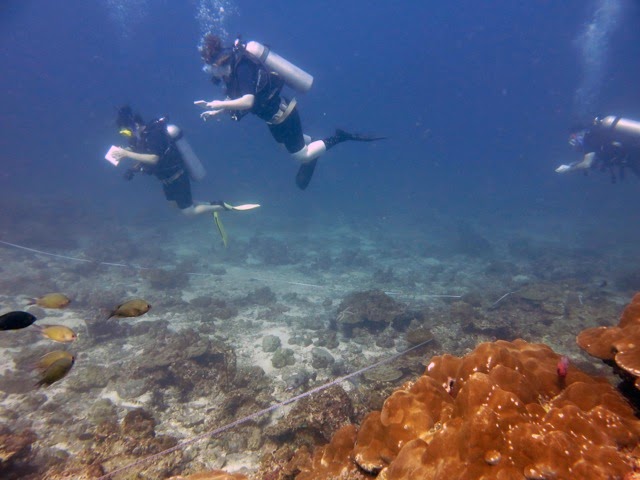
The divemasters sectioned off a 10 x 10 meter quadrat with a tape measure.  The students were to swim a grid pattern within the quadrat and evaluate reef condition using the criteria in the Reef Watch booklet.
Landon and Mor Mark on a near collision course while evaluating the reef.
Jessica.

Natalie, Jessica, Mikayla, and Maria (clockwise from the top).
Maria and Mikaya
After the reef evaluation was finished, the kids wanted to pose for the camera.  Here is Jessica.
Zach.
Landon.
Dom wais for the camera.
At the end of our final dive, a beautiful cuttlefish showed up to bid us farewell.
After the last dive was finished, Andrew and I breathed a satisfied sigh of relief that our 9th annual coral reef program was very successfully completed.

Coral planting

Today we planted coral fragments that had been growing in the nursery for the past year.  These are the fragments that last year's class prepared for the nursery. 


The first order of business was to take our underwater class photo.  I just snapped a quick picture as we were staging the group.  The official final photo was taken by Andrew with his high-end photo gear.
After the class photo, the students planted coral fragments into a dead staghorn coral reef.  Much of this reef is still very stable, although dead. By cable-tying the new fragments onto dead staghorn coral, we are able to give the reef the opportunity to become re-established.
Here is Dom attaching a fragment to a piece of dead staghorn.
It is critical that students have good buoyancy skills because they must stay off the reef when planting. Maria's excellent technique keeps her from touching the reef with her body or fins. We have been honing our buoyancy skills with a series of dives leading up to today.
Here is a newly attached piece of live staghorn coral.  We saw fragments that last year's class planted in this same reef and they're growing an doing very well.
I just can't resist taking photos of anemonefish (=clownfish) in the anemones.  They're so photogenic.

Sunday, January 11, 2015

Coral harvesting

Today we collected coral fragments from donor colonies on a healthy reef, brought them into the boat, and prepared them for the coral nursery.  The last dives of the day were to deposit the coral fragments into the nursery.

Adam and Manoj on the way out to the first dive site.
The Reef Ranger is our dive boat.
Andrew Hewett and a team of marine biologists from the Phuket Marine Biological Center harvested the coral fragments.
Andrew is examining the buckets of fragments.  Each colony is to be kept in a separate bucket to minimize stress to the corals.
We divided the students into teams to put the coral fragments into tygon tubes.
This team is Natalie, divemaster Jade, and Jordan.
Instructor Chris and his team are putting the tubes into a plastic mesh rack.
We prepared 26 racks today.
In addition to the staghorn coral that we worked on first, we also worked with larger foliose coral species and tied them to the racks with wires.

Raechel and Mikayla are rightfully proud of their work.
As they were completed, the racks were suspended below the water surface to keep the coral fragments alive.
After all the racks were finished, we swam them down to the nursery platforms.  Here is Zach transporting a rack.
 Maria.
Mikayla.
Manoj.
The platform holds 14 racks and there are two platforms. These fragments will grow here for a year and next year's class will plant them into a dead reef.
All the racks are attached to the nursery platforms with cable ties.
Cable tying requires someone above and below the racks so the ties can be fed through the holes.
After a long day, everyone is satisfied and happy.  Here are Shanon and Raechel.
Dom.
Mikayla.
Natalie.